Members of the phylum Ciliophora, as the name suggests, are distinguished by their cilia. The cilia is used for feeding - it sweeps the food particles towards the primitive mouth. It is also used for the organisms' movement in the environment. Organisms in this phylum mostly consumes bacteria or other protists. These solitary, fresh water organisms contain a large macronucleus along with several smaller micronuclei. The macronucleus is responsible for metabolic functions - digestion, respiration, and asexual reproduction. The smaller micronuclous provide pathways in sexual reproduction. Some organisms of the phylum Ciliophora reproduce asexually through mitotic division. Others reproduce sexually through conjugation. During conjugation, individual cells fuse together and exchange genetic material in form of small micronuclei.
Example: Paramecium
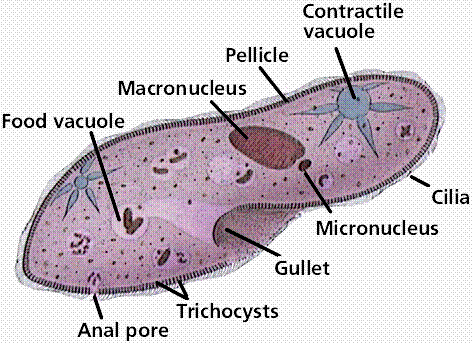 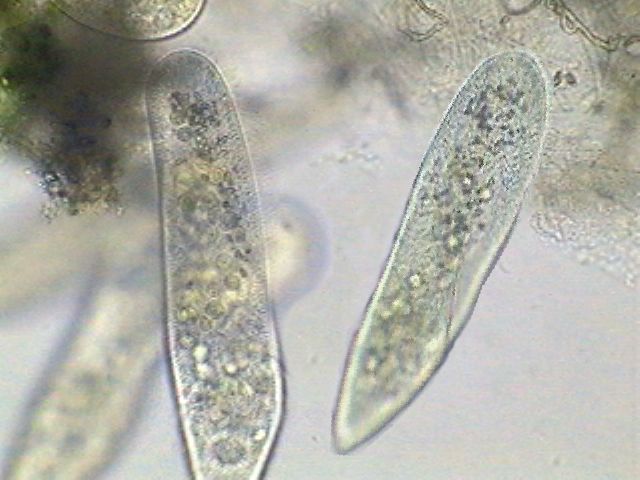 | The two images on the left show paramecium, a primary example of an organism of the phylum Ciliophora. As seen from the top image, paramecium has one large micronucleus (regulates sexual reproduction) and several micronuclei (regulates metabolic function). The vacuoles of paramecium make it distinct within the phylum Ciliophora. The ingested food is stored in the food vacuole, where various enzymes break down the food. The vacuole circulates throughout the cytoplasm and provides the food where needed. Paramecium also has a contractile vacuole that stores and expels water to control the amount of water inside the organism. Lastly, paramecium has a membrane called pellicle which is both stiff to provide support, and flexible to maintain its shape. |
